There are forms that seem to belong to an ancient memory, capable of evoking a sense of order and harmony that goes beyond their simple visual structure. Circles, triangles, spirals and polygons have accompanied human thought for millennia, entering architecture, art, mathematics and the spiritual traditions of many cultures. It is in this interweaving of form and meaning that sacred geometry is placed, a system of symbolic interpretation through which proportions and geometric relationships become tools for questioning the relationship between the human being, nature and the cosmos.
More than a unitary discipline, sacred geometry includes different conceptions and practices, developed in historical and cultural contexts that are also very distant from each other. What unites them is the idea that some geometric shapes can express a broader order, making visible what would otherwise remain abstract or invisible.
From ancient civilizations to the idea of a universal order
Since ancient times, mathematical knowledge has made it possible to measure land, orient buildings, observe celestial movements and define architectural proportions. In many civilizations, these skills have been intertwined with religious and cosmological beliefs, contributing to the construction of places for worship and the symbolic representation of the universe.
In Egypt, the precision of the proportions of the pyramids continues to arouse interest and inspire symbolic interpretations. However, it is important to distinguish archaeological data from esoteric readings from later times: not all mathematical correspondences identified in the pyramids demonstrate the existence of an intentional cosmological project.
In ancient Greece, the Pythagorean tradition attributed to numerical relationships a fundamental role in the understanding of harmony, linking the mathematical structure to the music and order of the cosmos. Proportion thus became a principle through which to interpret the relations between the parts and the whole.
This concept has traversed the history of Western thought, influencing philosophy, architecture and the arts in different ways. Geometry was not only a means of constructing or measuring, but also a language with which to represent ideas of balance, perfection and transcendence.
The Symbolism of Geometric Forms
In sacred geometry, elementary figures take on symbolic meanings that vary according to traditions and contexts.
The circle is frequently associated with unity, continuity and infinity. It can evoke the cycle of life, the movement of the stars or the idea of totality.
The square often recalls the stability, the measurement and the relationship with the Earth's space. Its orderly structure may suggest a principle of organization and balance.
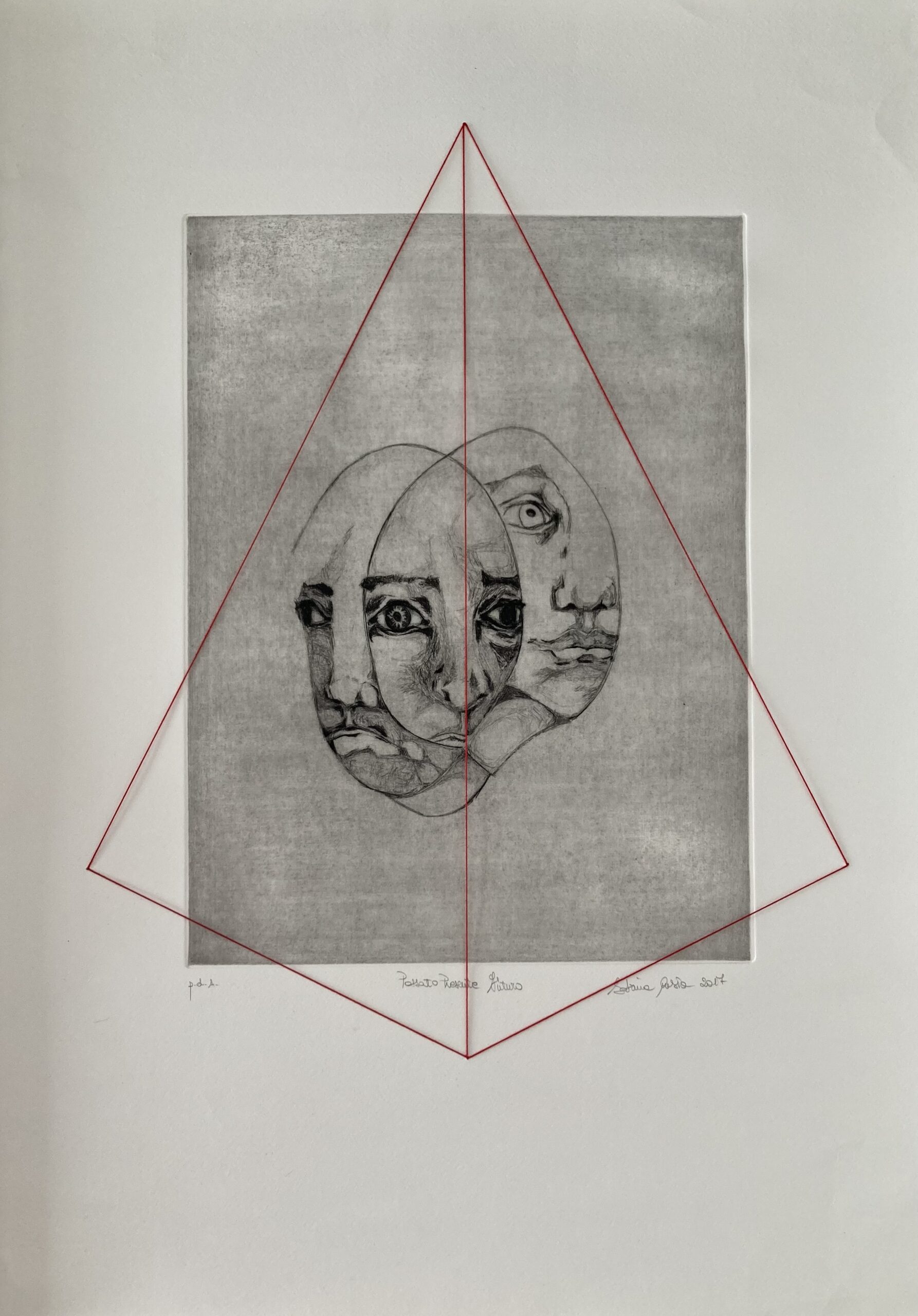
The triangle can represent the ascent, upward tension or union of distinct elements. In some religious traditions it takes on meanings related to the trinity, while in other contexts it is interpreted as a symbol of transformation or relationship between different dimensions.
The spiral suggests movement, growth and transformation. Its course can evoke a path that develops progressively, returning to itself without ever fully coinciding with the starting point.
Nature between forms, proportions and recurrences
The observation of nature has contributed profoundly to the birth of geometric thinking. From the symmetries of crystals to the structures of shells, from the ramifications of plants to the configurations of some organisms, the natural world presents regularities that can be described through mathematical models.
Among the best known proportions is the golden section, a mathematical relationship associated with about 1.618, which has aroused interest in mathematics, art and architecture. The Fibonacci sequence also presents mathematical relationships that are found in some plant dispositions.
In the perspective of sacred geometry, these recurrences are often interpreted as indications of a correspondence between the structures of nature and a broader order. From a scientific point of view, however, they can be understood through specific physical, biological and mathematical processes.
From geometry to inner experience
In some spiritual practices, the drawing of geometric figures, the construction of mandalas and the observation of symmetrical configurations become instruments of concentration and recollection.
The repetition of a line, the precision of an angle or the circular movement of a composition can favor a more conscious attention to the gesture and the creative process.
In this sense, geometry can become a practice of listening and inner organization.
The relationship between geometry and spirituality is therefore configured as a possibility of personal research, in which mathematical precision meets the subjective dimension of experience.
Geometry in art: between structure and intuition
In the visual arts, geometry performs a function that goes beyond the simple organization of composition. It can establish hierarchies, create tensions, orient the gaze and build relationships between solids and voids, surfaces and volumes, figures and backgrounds.
From medieval sacred art to the experimentations of abstractionism, geometric forms have been employed to express both a rational order and a spiritual or emotional dimension.
In contemporary art, this language continues to offer possibilities for research. Geometry can be used to investigate the relationship between body and space, matter and image, perception and meaning. It can suggest a hidden structure, create a visual rhythm, or introduce an element of balance within an unstable composition.